
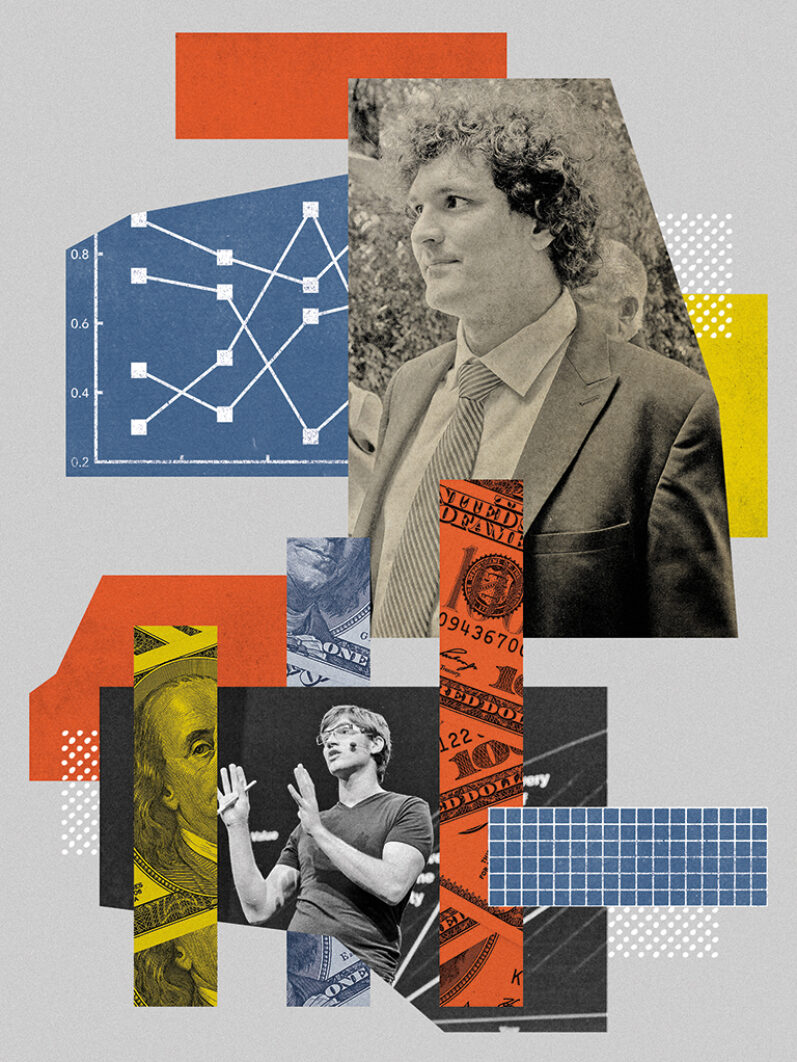
Editor’s note: This article was originally published on 20 September. On 3 November, “Crypto King” Sam Bankman-Fried was found guilty of fraud and money laundering. Sophie McBain looks at whether the idealist effective altruism philosophy will survive his conviction.
The moral philosopher met a brilliant American maths student who wanted to know how he could do the most good in the world. How about becoming a banker, the philosopher said.
No, seriously.
Think of it like this. With his high grades, the student could do pretty much anything. He could become a doctor in a poor country, and then he might perform life-saving surgery ten times a week, saving 500 lives a year. But if he became a banker he could donate enough money to finance the salaries of ten doctors, saving ten times as many lives. Plus, if he didn’t become a doctor, someone else was likely to do the same job. But if he didn’t become a banker, who else would step in to fund the doctors?

William MacAskill, the moral philosopher, was a leading “effective altruist”, someone who thought about morality in a scientific way, crunching the numbers to determine the “best” method of helping others. He had helped found a careers-advice organisation pitched at top graduates, one that encouraged would-be aid workers to consider more lucrative work so that they could “earn to give”.
[See also: “The biggest Ponzi of all time”: why Ben McKenzie became a crypto critic]
And so the American maths student, Sam Bankman-Fried, took a job in finance, where he developed an interest in crypto. He set up his own firm and went on to make billions on crypto arbitrage, taking advantage of the price discrepancies that can arise in the digital-currency markets. He pledged hundreds of millions in donations, mostly to organisations linked to his friend, the moral philosopher. In interviews the student, by now a famous crypto king, explained that your incentives are different when you are making money in order to give it away. When you’re doing good, there are no diminishing marginal returns – and so it makes sense to take bigger gambles, to be aggressive.
But the crypto king was also taking different kinds of risk. In December 2022 he was arrested and accused of defrauding his customers, owing them approximately $8bn. In February 2023, he asked his donees to return their gifts, or risk them being seized during bankruptcy proceedings.
On Twitter the philosopher expressed his “utter rage” at the crypto king, and his “sadness and self-hatred” for falling for his deception. He acknowledged that he had not heeded concerns that his own moral ideas could be misused. The crypto king’s actions ran contrary to effective altruism, which emphasises “the importance of integrity, honesty and the respect of common-sense moral constraints”, he tweeted.
Which would have been an adequate response if the story of the moral philosopher and the crypto king were merely a thought experiment, an abstract scenario used to test an idea. But real life is messier and more complex. On 2 November, the crypto king was convicted in a New York court on seven counts of fraud and money laundering. Questions have been asked of the philosopher, too: how much did he know? Was his big idea fundamentally flawed?
The story of how the Oxford philosopher MacAskill and the effective altruism (EA) movement found itself entangled with the disgraced Bankman-Fried is partly about moral principles. Why should someone like Bankman-Fried find EA’s ideology so compelling – or at least convenient? But mostly it is about politics, the corruptive influence of power and money – the unforeseen (but not unpredictable) consequences of telling people that the best way to do good is to get rich.
Now, a thought experiment. Imagine you find a toddler drowning in a shallow pond. Should you wade in and save them, even if your clothes get muddy? Well, of course! Would you agree, then, that if it’s in your power to stop something very bad from happening, at minimal cost to yourself, you should do it?
What if a child is at risk of drowning in floodwaters many thousands of miles away, and a small donation could save their life? In his 1972 paper “Famine, Affluence, and Morality” the Australian philosopher Peter Singer argued that failing to contribute to disaster relief is morally equivalent to walking past a drowning toddler. Our moral obligations are much greater than almost anyone is willing to acknowledge, he wrote. It is morally wrong to buy unnecessary things – like new clothes – when we could be giving to life-saving causes.
Some people encountering Singer’s paper for the first time will try to find holes in it; others might not bother. It is much easier to file this argument alongside the other inconvenient information we’re required to ignore if we are to enjoy buying pointless stuff on this ever-warming planet. Effective altruists are different. They are generally people who have always taken morality far more seriously than their peers. They were the kids who turned vegetarian aged six and gave all their pocket money to charity, who volunteered at the local homeless shelter. Some have donated a kidney to a stranger; some volunteered to take part in Covid vaccine trials.
When the Bankman-Fried crisis broke, Julia Wise, the US-based community liaison for the Centre for Effective Altruism, said she felt “horrified and disappointed”. “So many people in the community had made really thoughtful choices about how to help others, and here was this person acting so recklessly and undoing other people’s good work,” she told me. A year on, she said most EAs were setting their outrage aside, as “all these important problems in the world are still there”.
Alongside the extreme do-gooders, EA has long fostered a darker, millenarian streak. Since Bankman-Fried’s downfall, it has faced more reputational crises. In January this year, an email written in 1997 by Nick Bostrom – a futurist philosopher whose ideas are influential within the movement – resurfaced in which he used the N-word and said he believed that black people are more stupid than white people. (He apologised for “this disgusting email from 26 years ago… [which] does not accurately represent my views then, or now”, while adding that inequality leads to differences in skills and co